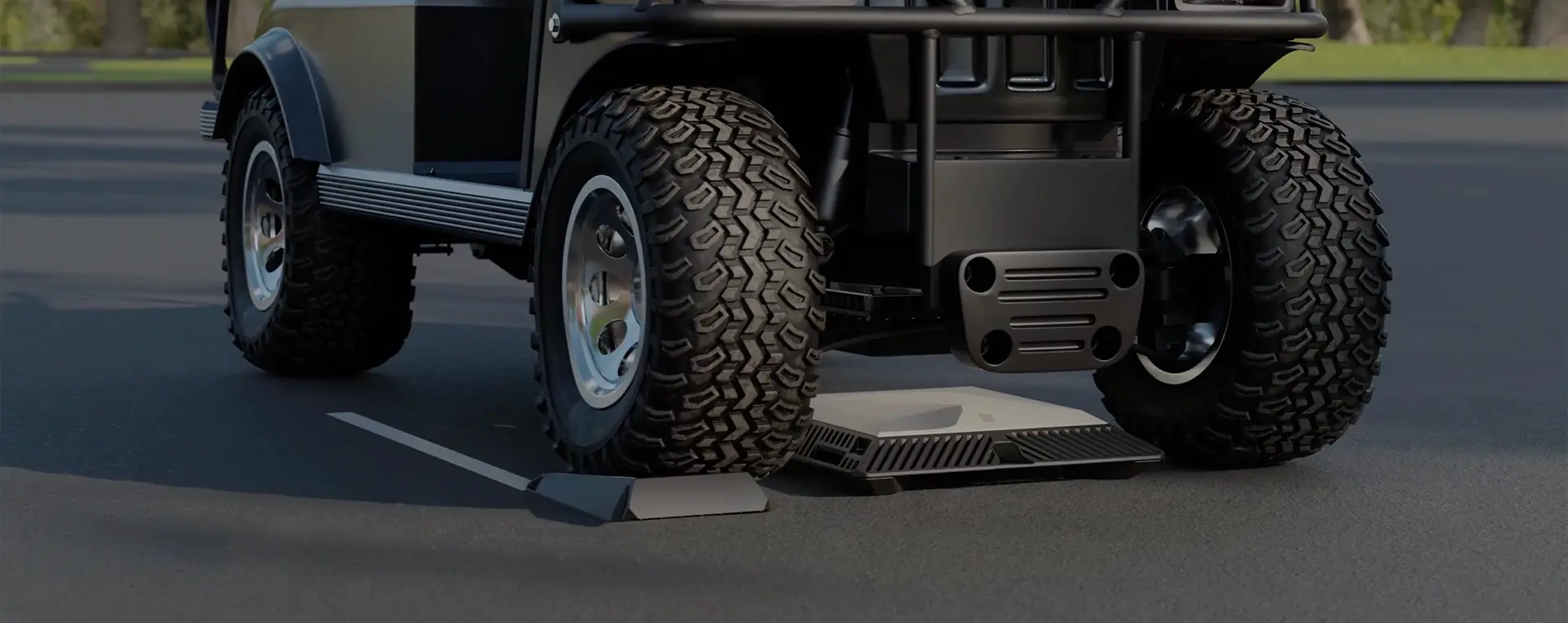
How does WiTricity wireless charging work?
+
WiTricity's patented magnetic resonance (MR) technology enables the highly efficient transfer of power over the distance between a transmitter coil and a receiver coil without any physical connection. Power is transferred using a localized magnetic field. The system is fully automated, with no moving parts, reducing maintenance while ensuring reliable performance.
Resonant coils - Both the transmitter and receiver have coils tuned to the same resonant frequency, much like a radio tuned to pick up a specific station. Once a wirelessly equipped vehicle is parked over a transmitter (also called a ground pad), charging begins automatically. AC power from the grid flows into the transmitter, which generates an oscillating magnetic field. That magnetic field induces a voltage in the receiver coil.
Energy transfer between the transmitter and receiver - Unlike a wireless phone charger, which requires the charger and the device to be very close together and aligned perfectly, the receiver captures the oscillating magnetic field from the transmitter over a significant air gap.
Conversion to electricity – AC voltage induced in the coil in the receiver is then converted to DC electric output which is connected to the battery which will charge up.
What are the advantages of magnetic resonance?
+
Magnetic resonance delivers wireless power over an air gap, scaling from Watts to hundreds of kilowatts –
just as fast as plugging in! There are four major advantages: spatial freedom, multiple devices powered by a single source, the ability to power through surfaces, and scalable power transfer.
See why magnetic resonance is the only technology that meets automaker requirements for wireless charging.
How does WiTricity’s technology differ from mobile phone charging?
+
Inductive charging technology, like that used in mobile phones, requires the transmitter and receiver to be in close contact and with perfect spatial alignment. Magnetic resonance charging is very forgiving. It allows power transfer over distance with greater spatial freedom, so the vehicle doesn’t have to be perfectly aligned with the charging pad for the system to work.
How efficient is WiTricity’s technology?
+
The use of resonance, cutting-edge power electronics, and clever control algorithms is why WiTricity's systems provide up to 93% grid-to-battery electrical efficiency, matching that of most plug-in charging systems.
Over what distance can WiTricity’s technology transfer power?
+
WiTricity's technology can be engineered to meet the practical requirements of many use cases, including neighborhood electric vehicles (NEVs), cars, trucks, buses and other vehicles. The distance over which a system can transfer energy depends on the size of the resonator coils and the application requirements.
Can WiTricity’s technology transfer power through ice and snow?
+
Yes, WiTricity can transfer power through ice, snow, and also asphalt and cement – with no loss in electrical efficiency.
What is WiTricity doing to ensure interoperability?
+
WiTricity was instrumental in helping to develop and harmonize international standards through its leadership and participation in industry groups including SAE International, IEC, ISO, and others globally. We continue to help lead the effort to ensure standards for all aspects of wireless charging.
I’m interested in wireless charging for my fleet
For what type of commercial electric vehicles (CEVs) is wireless charging available?
+
WiTricity wireless charging is being developed for NEVs, passenger cars, and fleet applications.
How can WiTricity determine the benefits of wireless charging for my electric fleet?
+
The best way to determine the benefits of wireless charging for your electric fleet is to work with us to develop a pilot. You’ll find that, unlike plug-in chargers that require time-consuming, hands-on labor, clutter the ground, and require excessive maintenance, WiTricity’s ruggedized charging pads add power to battery-electric vehicles quickly and automatically during scheduled stops and overnight dwell times. The combined speed, power, safety, and hands-free nature of WiTricity wireless charging is the most advanced way to enable electric trucks to match the range and duty cycle of their legacy diesel counterparts.
How is wireless charging safer than plug-in charging?
+
Wireless charging is free of cables and moving parts, so there is nothing to trip over, run over, break, or freeze. This ensures risks to workers are minimized while revenue-generating operational uptime is maximized.
How does the cost of wireless charging compare to legacy plug-in and other conductive technologies?
+
For many common applications, the cost of ownership calculations show that wireless provides significant savings over legacy plug-in charging. Much of these savings come from a system that is fully automated, has no moving parts, and can be deployed in already cramped depot spaces or highly trafficked areas – all of which enables successful electrification at a lower cost. Contact us for a custom total cost of ownership calculation.
How does wireless charging help eliminate range concerns?
+
Wireless charging allows vehicles to charge automatically during scheduled stops, such as loading/unloading or rest breaks. Being a fully automated, park-and-charge technology, wireless charging can happen more frequently during the day without interrupting a truck or bus operator’s primary tasks. With a small footprint, the systems can be deployed more easily in more places, making charging more readily available. This means, in certain applications, wirelessly charged vehicles can run charge-neutral, meaning their state-of-charge at the end their days can be the same as it was at the beginning.
How does wireless charging help reduce battery size and cost?
+
The large batteries required for certain bus and truck duty cycles add to the cost and weight of already expensive EVs for this application. Fast and automated wireless charging during scheduled breaks keeps EVs charged throughout the day and reduces the need for larger batteries.
How does wireless charging reduce EV charging maintenance?
+
Wireless charging is free of cables and moving parts, so there is nothing to break or freeze. In addition, vandalism is reduced since there’s nothing to steal.
How does wireless charging impact my business compared to legacy plug-in charging?
+
If transitioning from internal combustion engines to electric, wireless charging minimizes the impact. Automated and hands-free, wireless charging has no mechanical contact or human intervention required. This means that charging opportunities are maximized without the need to add manual labor or remove vehicles from operational duty to be charged. Vehicles charge throughout the day, minimizing downtime and lost revenue opportunities.
Does your wireless EV charging system have vehicle-to-grid (V2G/V2X) capabilities?
+
Yes, our latest generation of wireless charging does provide V2G/V2X capabilities.
Where can I see WiTricity in action?
+